
Obsessions
Preoccupation and sacrifice are mandatory for success

Peter Drucker, the great management guru whose name is plastered on the walls of my graduate school, said,
“If you have more than five goals, you have none.”1
Stephen Covey, author of The 7 Habits of Highly Effective People, urged readers to
“Put first things first.” 2
Mihalyi Csikszentmihalyi, the father of Flow, quoted one of his participants as saying,
“To be totally absorbed in what you are doing and to enjoy it so much that you don’t want to be doing anything else. I don’t see how people survive if they don’t experience something like that.” 3
And I’m sure there are many, many other quotes I could pull (like from Angela Duckworth’s work on the concept of grit and 10,000 hours of dedicated practice being the soft, round number estimation baseline for greatness).
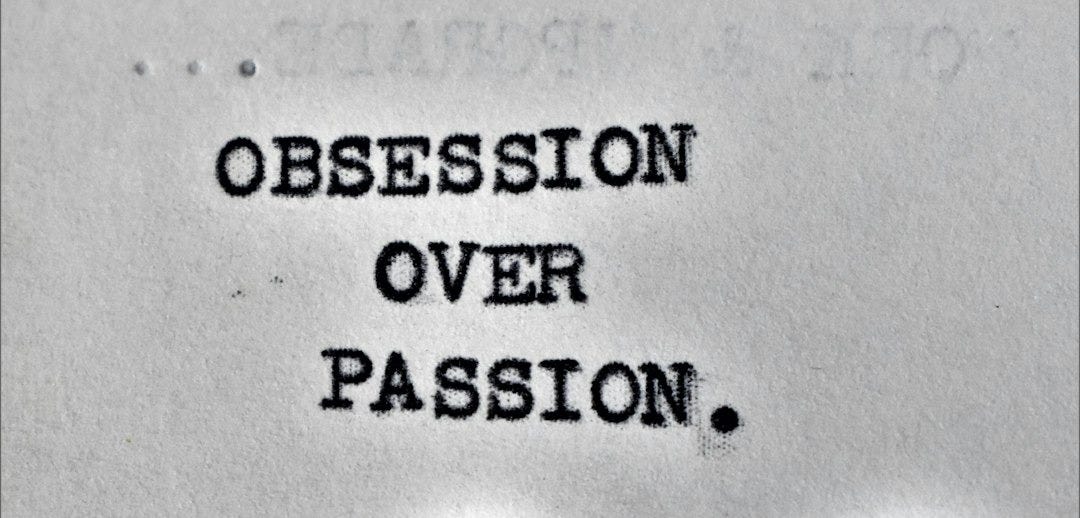
All of this to say…being obsessed is a good thing. And, in my case, a necessary thing.
As a point of order, there need be no quibbling about the joys or dangers of being a little obsessed versus absolutely obsessed. By definition, obsession is an immersive preoccupation with something or someone. Being a little obsessed is an oxymoron, while being absolutely obsessed is redundant. Obsessed is enough. Actually, it’s more than enough—but necessarily, linguistically, enough.
I have passions that don’t amount to obsessions.
I’m passionate about mindfulness, for example, but don’t meditate every day. I’m passionate about psychology, but would rather listen to 80’s female-artist rock ballads than any of the several podcasts I’ve subscribed to. I’m passionate about human rights, but don’t attend protests.
My passion for these things doesn’t equate to dedicated time (well, maybe the psychology one gets dedicated time), and in any case, not at the expense of all other obligations.
But if I want to achieve a goal, then passion isn’t enough.
Passion + Time - all other obligations = Obsession
This equation explains how obsessions take our passions and consume our time such that we must sacrifice other activities. If we aren’t doing that, it’s not an obsession. It’s a hobby.
Obsessions can be a bad thing, sure.
If you’re stalking your ex-boyfriend, eavesdropping on your boss, or spending all your money on throw pillows that have images of Disney characters—yeah, you might want to cool it. Especially if you don’t want to get arrested, want to keep your job, or want normal people to feel welcome in your home and have a place to sit.
You know you’re obsessed when…
There are two distinct activities that I can say without hesitation were obsessions for me in the past. They fit the definition above perfectly.
#1 My stories
In high school, I was so obsessed with writing a story that I didn’t do my homework, I stayed up all night, and I completely took over the living room floor with my cut-out plot points, character profiles, and outline drafts. My father had to ask me to please make a walkway, for Pete’s sake. I loved school, but even my assignments took a back seat to my developing narrative. I would be so immersed sitting cross-legged on the floor that my legs would go numb, I’d forget to eat, and I’d suddenly realize it was after 2 am and I needed to go to sleep.
It was also around that time that I learned about hypomania, but I’m going to leave that discussion for later.
Finally, a couple of summers ago, in between getting my master’s degree and starting the PhD program, I decided I’d finally finish writing the memoir I’d started six years prior. Every day, I didn’t do anything else, sometimes not even get out of my pajamas, until I had written at least four pages. Because I couldn’t think about anything else, I often wrote more. Within two months, I had a manuscript of over 200,000 words. My first draft was a beast.
#2 Losing weight
This one is not so fun or healthy to recount, but it was absolutely an obsession. And, like my writing, when I was truly obsessed, I was “successful.”
In high school, I became so obsessed with losing weight that I stopped eating and started exercising outside of my daily P.E. classes. I would do jumping jacks at night instead of sleeping. I took Hydroxycut, which, believe it or not, I was allowed to purchase over the counter at fifteen years old. Not eating, or very restricted eating, made me think about food all day, so I wasn’t getting homework done. The legal uppers I was on made not sleeping and over-exercising easier. NOT a healthy obsession.
Years later, when my son was four years old, and I was preparing for my wedding, I became obsessed with losing weight again. This time, I wouldn’t do anything—not make my bed, not shower, not do the dishes, not go to work or do college homework—until I’d gone for a run and done a workout video. I was on the SlimFast diet, meaning a shake and a bar for breakfast and lunch, then a salad or soup for dinner. Sure, I wasn’t on uppers anymore, but my other responsibilities were sacrificed to make sure my weight-loss efforts came first.
And it worked. I reached my goal weight by my wedding day, even if I was a crabby bitch for several months leading up to that day.
Current obsession: Interpretative Phenomenological Analysis
I now have the freedom, nay, the obligation to become absolutely obsessed with these goals.
Listen, I’ve tried moderation. It’s only three months into my new self-directed lifestyle (and accompanying Vow of Poverty), and I’ve spent more time enjoying my slow mornings, “working” with friends (let’s be honest, there’s always more chit chat than productivity), and consuming other memoirs than I have working on my own.
Today, I tried to embrace an “obsessed” mindset. Before even eating breakfast, I got an hour of data analysis done. Throughout the day, I kept coming back to my computer and giving all of my attention to reading a transcript and writing experiential notes. Once I really dived in, I didn’t want to stop. My carefully constructed day had gone out the window, but I had gotten so much done. And that felt really good.
The method of analysis I’m using, Interpretative Phenomenological Analysis, practically requires that I’m obsessed. If you’re interested (who would be? Crazy people like me, I guess), check out this chapter: Chapter One.
If I’m not obsessed, this whole process is going to go a lot slower.
You know what I never did with my true obsessions?
Procrastinated.
Everything else could go to shit, but whatever I was obsessed with got DONE, and I enjoyed the process of doing it.
This phenomenon of losing track of time while engaged in an activity you enjoy that gives you consistent feedback on your performance is called flow.
I’m trying to be obsessed because moderation and consistency are hard. Obsession, however, is consuming, and because I want to do the thing, it doesn’t feel like something I have to do. Once I made publishing this book and doing this Ph.D. my job, I had a sense of have to. Which meant resistance. Procrastination.
But if I can become obsessed with IPA (Interpretative Phenomenological Analysis, dude, not the beer) and querying agents while continuing to line edit my manuscript, then all other activities are no longer distractions because I don’t want to do them as much as I want to analyze my data and publish my book. It’s a mind trick, of course. Let’s see if it works or if I burn out.
Have you ever been obsessed with something?
What was it?
Was it good for you?
Please leave a comment letting me know. I’m wondering, too, if anyone has ever intentionally tried to get obsessed with something like this.
And if you’re looking for more proof that obsession can be a good thing, check out this Psychology Today article from 2021: The Benefits of Harnessing Obsession | Psychology Today
Thank you for reading What We Have Learned
If you’d like to support my work, please consider:
Clicking the ❤️ below to indicate you like what you read
Commenting. I really would love to hear what other people are obsessed with!
Sharing this post with others—either here on Substack by restacking, or by linking to it on social media channels
Subscribing or upgrading to a paid subscription
Buying me a coffee or glass of wine to fuel the muse:
Related posts


Drucker, P. F., Hesselbein, F., & Kuhl, J. S. (2015). Peter Drucker’s five most important questions: Enduring wisdom for today’s leaders. John Wiley & Sons. p. 63.
Covey, S. R. (1991). The seven habits of highly effective people. Provo, UT: Covey Leadership Center.
Csikszentmihalyi, M. (2020). Finding flow: The psychology of engagement with everyday life. Hachette UK. p. 116