
Women's Work
Carry all the things all the time and be grateful that you get to

“We should sing karaoke,” my friend asserts as we drive home from the grocery store. I couldn’t agree more. I love singing karaoke. I don’t care if I’m good, by the way. If you showed up, that’s your fault.
I get home and listen to Spotify while putting away my groceries. When the song “Joey” comes on by Concrete Blonde, I sing it by heart even though I haven’t heard this song in at least a few years.
Hey, I’m not half bad! Maybe I’ll sing this at Karaoke.
I play the song again.
“And though I used to wonder why, I used to cry till I was dry. Still sometimes I get a strange pain inside. Oh, Joey, if you’re hurting so am I.”
Suddenly, I’m crying my eyes out. The words hit me in the middle of my chest, and I realize she’s singing about being with someone who has an addiction. Or at least that’s how I’m interpreting it now. And the lyrics and desperation in her voice are now mine and are pouring out how I felt when I was with my husband.
I’d had plenty to complain about when I was married. And I already lamented having to go back to the same courthouse this week where I’d filed for divorce.

But admitting that I was the spouse of an alcoholic? No, I don’t think I had ever quite admitted this to myself. Why now, with the serendipitous help of a silly song?
After the new year, my friends from around the world checked in on one another. One of them sent a sweet picture of her cuddling her dog and admitted she’s been struggling a bit, emotionally.
The murder of a woman in Minnesota (I don’t think I even need to explain) had us all shook, but my friend was dealing with something closer to home.
She’s the only one in her household earning any money. She’s married with children and is holding it all together by herself. As if that weren’t enough pressure on its own, her husband isn’t emotionally available and doesn’t seem aware of the mental load that he could share by handling just some of the logistics at home.
Of course, after expressing this frustration, she rushes to add that they love each other, and he has recently been physically disabled.
She might feel less stressed if she weren’t about to start her period and if she could just get laid (it’s been months).
Another one of our friends offers her own experience with her spouse being laid off because of COVID. Her spouse also had health issues that required her attention and care. She admits that she felt overwhelmed, even without kids.
In this same group of friends, another woman is facing the anniversary of a sexual assault. Rape. She had written about it, hoping for the writing to be therapeutic in a way, but was also aware that she was going against the legal advice she had received to not talk about it. Not only that, but to not talk about how she took care of herself afterward. How she was able to have moments of joy or respite and even enjoy the company of other partners.
She is also the sole financial provider for her and her partner, who was laid off in the spring of last year.
“But you do it all,” she says in our group chat, “because you love them.”
The youngest friend in this group pipes in her condolences and informs us that her partner hasn’t had stable income for more than half a year. She has been the only one to pay any rent.
I want to scream, “HOW ON GOD’S GREEN EARTH is this happening to different women, of different ages, across different countries?”
I walk to a coffee shop to get some work done on my memoir, where the opening chapters establish just how unstable and unreliable my husband was.
A woman I barely know tangentially, but have known for years anyway, is there, so I sit and chat.
I learn so much about her over a two-hour conversation. Among the things she’s been through that she shares with me is her fight to be heard and taken seriously by her doctors. After doing her own research, she finally had a doctor confirm that she had IBS and her vagal nerve was getting irritated due to complications affecting her pelvic floor.
“We are just expected to be in pain all the time,” she tells me. “So, when we say, ‘Oh, this isn’t right,’ the doctors assume we don’t know our own bodies and presume to tell us what they think is wrong. Meanwhile, we’re just complaining too much.”
She’s a lawyer and has recently retired from mentoring international students who come to the US with all sorts of different cultural expectations.
“What we think is violent here is normal for some of them,” she tells me. “What we think is traumatic, they are not traumatized by because it’s just expected.”
I learn from her that Denmark banned the burqa back in 2018. I immediately think: How radical! Make it a crime to wear one, and men can no longer force women to hide themselves. Progressive and subversive. Love it.
“Ah,” I say, “so the men can’t…”
“No, it’s not the men that are mad. It’s the women!”
I wonder at this.
“Is it internalized sexism?” I ask.
“No, it’s the women who tell their daughters to stop being indecent. It’s the women who use shame to control.”
On my LinkedIn feed, a former professor has posted a recent article in which she and her team have validated a short form of the DARVO assessment.
DARVO stands for: Deny, Attack, Reverse Victim and Offender. It’s what narcissists do. It’s what perpetrators of intimate partner violence do. It’s gaslighting.
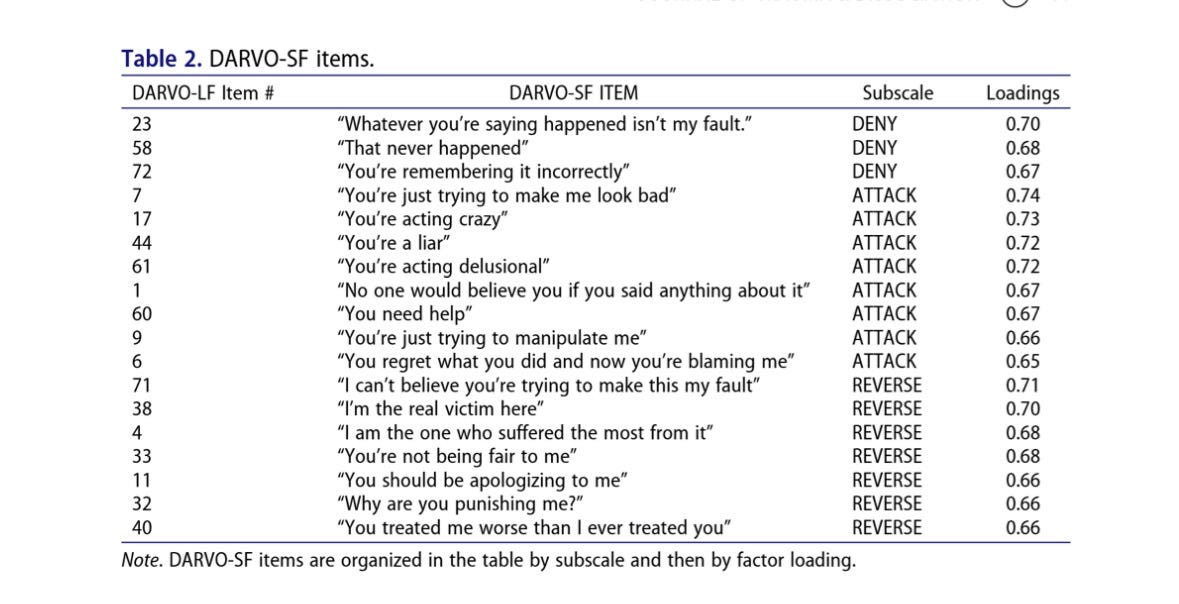
How blatantly familiar these phrases are to me. I lived with them for years before I decided, my fault or not, I’m getting out.
How quickly my friends were able to resonate with one another’s pain while also reassuring the rest of us.
How easily my coffee-shop friend had been dismissed by her doctors.
How conditioned we are, as women, to appease as the first order of business and then maybe, maybe assert our own need for support as a subsequent order of business. And then apologize for it.
I called my friend who had accompanied me to the grocery store. “I know we just saw each other, and you’re probably still putting away groceries too, but would you come over, please? Can I borrow you for just ten minutes?”
“I’ll be right there.”
When she arrived, I had stopped crying, but my chest was still heavy, my face puffy.
“I didn’t want to get divorced,” I tell her. “I wanted things to get better. I always just wanted things to get better.”
She hugs me. “You did the right thing, girl. And you’re so strong!”
I squeeze her back. “Still feels like shit.”
She listens to “Joey,” and I explain about the alcoholism.
“Have you ever thought of joining a group?” she asks me. No one has ever asked me this before.
“Seven years after the fact?” I laugh. “A little late, don’t you think?”
“Well, you did say you never admitted it to yourself. Maybe now that you have, it could help.”
Why is it always the spouses/partners of people with problems that go to group/therapy and not the person with the actual problem that’s causing all the stress in the first place?
When she leaves, I turn Spotify back on and make some tea. Then another song comes on that I belt aloud from memory:
“And all I really want is some justice…”
Stop seeking approval from people you don’t approve of.
This thought occurs to me as I wonder how I should approach a potentially uneasy conversation with someone from whom I need something. If I’m direct, they may back away. If I’m too coy, they may enjoy their power and use it. Not to mention I’d piss myself off for compromising my own integrity.
But sometimes, most of the freaking time, that is exactly what women must do. We must subdue the righteous anger or even minor annoyance at being put out, relied too much on, or not believed, to keep from being punished or making things worse.
Psychologists call this the fawn response. Women know all too well that if they don’t act carefully, a bad situation could be made much worse. And then they are shamed for not acting differently.
Women who carry the burden of every responsibility for the family or couple unit are shamed if they dare complain. Or, if she isn’t shamed, she internalizes the narrative that she should be okay with it because “we love them.” Even when it hurts, and we don’t get more than a pat on the back from fellow women who say, “I’ve been there.”
I’m finally reading Eat, Pray, Love. I watched the movie years ago when my aunt, in response to my complaints about having to always be the stable one, the planner, the fixer, in my marriage, told me, “You need an Eat, Pray, Love. Watch the movie. You’ll see what I mean.”
I now watch that movie every time a romantic relationship ends. It’s my official heartbreak movie. Valid criticisms notwithstanding, it always makes me feel better.
Now, reading the book, there are so many passages that exemplify just how normalized this woman’s work is. Here is one.
“This is how it looked to me, anyway, taking into account that nobody (and especially not the children) ever knows the secrets of a marriage. What I believed I grew up seeing was a mother who asked nothing of anybody.
…
“I told her everything. I told her how much I loved David, but how lonely and heartsick it made me to be with this person who was always disappearing from the room, from the bed, from the planet.
“He sounds kind of like your father,” she said. A brave and generous admission.
….
“Then my mother shocked me. She said, “All those things that you want from your relationship, Liz? I have always wanted those things too.” (Chapter 28)
Here is one more.
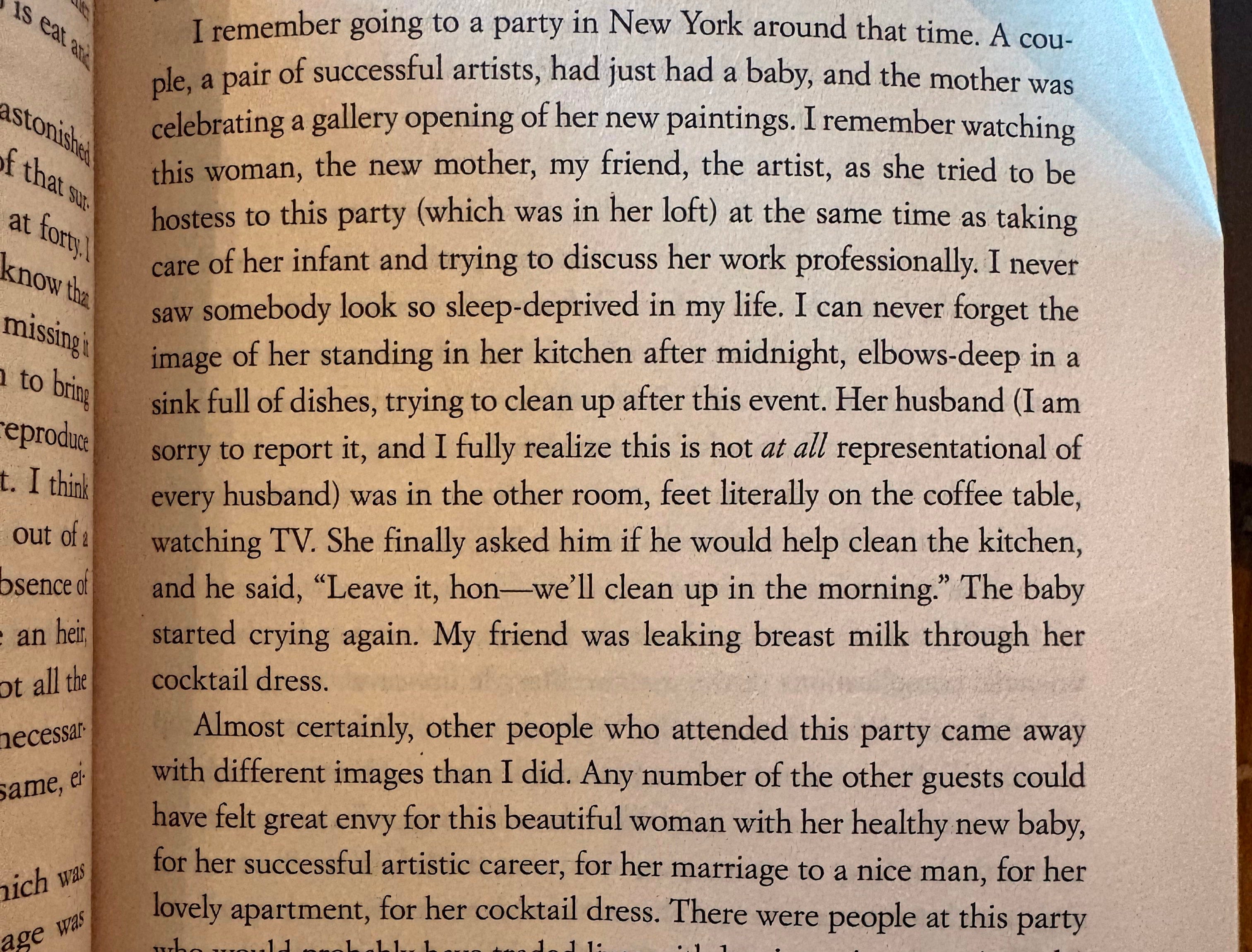
On the not-so-rare occasions that I’ve had a conversation with a man who does not believe feminism is needed anymore, I’ve given up. Honestly, I don’t know how they can’t see it. I guess that’s privilege for you.
When I feel that fawn reflex come on board, I want to work to gently tap it down. I want to normalize getting angry at the injustice of it all. I want to normalize saying, “Nope, not today, Satan,” and walking away from situations and men that do not serve me, appreciate me, or reciprocate the energy demanded of me.
But before I march off into the sunset to declare my not-so-new-but-ever-evolving manifesto, I’ll acknowledge that this too is women’s work. The work to undo the conditioning and to rebuild.
Thank you for reading What We Have Learned
If you’d like to support my work, please:
Click the ❤️ below to indicate you like what you read
Leave a comment
Share this with a friend who might like to read it
Subscribe to get posts straight to your inbox each week.
I write better when I’m sipping wine or tea.
Related Posts
Sex is Currency

An uncomfortable truth came tumbling out of my mouth during a recent conversation. This often happens because I have no filter.
Feminism in Action

I respect him. I do. He’s a great colleague. He knows his stuff. Very knowledgeable. I’m lucky to know him, I suppose.
Oh, how I can relate to this. Excellent!